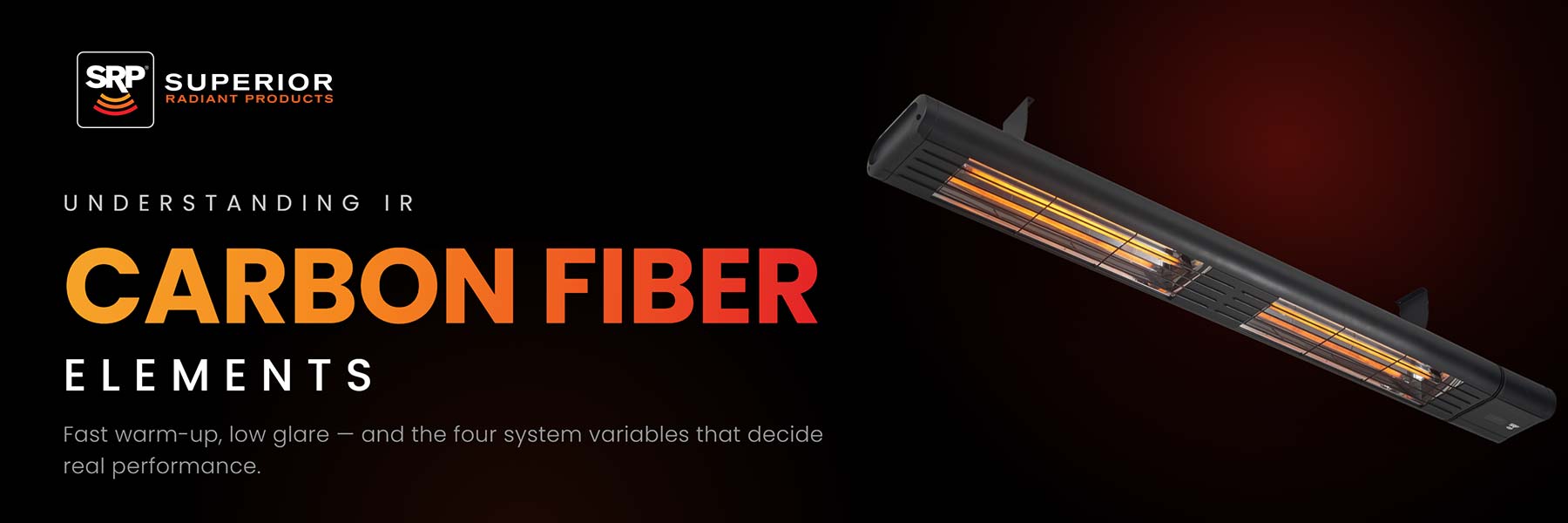
A carbon fiber heating element is an infrared emitter using carbon filament rather than metal wire, valued for fast warm-up and long service life. It operates in the medium-wave infrared spectrum, producing comfortable radiant warmth with minimal visible light glare compared to short-wave halogen lamps.
It is a genuinely good technology. However, when specifying commercial or architectural electric heating, mechanical engineers, architects, and design-build contractors must evaluate the complete radiant system, not just the emitter element in isolation.
How Infrared Emitter Technologies Compare
| Element Type | Warm-Up Time | Wavelength Band | Visible Glare | Service Life Expectancy |
|---|---|---|---|---|
| Halogen / Short-Wave | Instant (1–3s) | Short-Wave | High (Harsh Red/Yellow) | 1,000 – 2,000 Hours |
| Quartz Tube (Bare) | Under 1 Minute | Short-Medium | Moderate | 2,000 – 5,000 Hours |
| Carbon Fiber Filament | Instant (3–5s) | Medium-Wave | Low Soft Light | 5,000 – 10,000 Hours |
| Coated Medium-Wave Quartz | Under 1 Minute | Medium-Wave | Ultra-Low Glare | 5,000 – 10,000+ Hours (~10× Quartz) |
Key Advantages of Carbon Fiber Emitters
- Advanced Carbon Sock Tech: Woven carbon sleeve element operates cooler with less glare than traditional coiled wires, delivering gentle warmth without harsh light or hot spots.
- Extended Service Life: Resists thermal fatigue and structural degradation far better than conventional short-wave tungsten wires or bare quartz lamps.
- Architectural Low-Glare Comfort: Operates within the medium-wave spectrum to convert input energy into comfortable, deep-penetrating warmth without flooding premium spaces with harsh, intrusive red light.
- Uniform Linear Distribution: Continuous filament construction delivers balanced, edge-to-edge thermal coverage across the entire length of the tube with no cold spots.
Where Element Type Stops Mattering: The 4 System Variables
An outstanding heating element in an un-engineered housing still delivers mediocre warmth to the floor. When specifying outdoor electric radiant heat, real-world performance is determined by four critical system engineering variables:
- Reflector Optical Geometry: Infrared energy travels in straight lines until reflected. A patented geometric parabolic reflector captures over 90% of emitted energy and focuses it downward onto occupants rather than letting heat escape upward or scatter sideways above seating areas.
- Supply Voltage Matching (208V vs. 240V): Most North American commercial facilities operate on 120/208V 3-phase power. Installing a standard 240V heater on a 208V line reduces heat output by 25% due to Ohm’s Law (Power = V²/R). Specifying native 208V commercial models ensures 100% rated heat delivery.
- Housing Seal & Termination Protection: Infrared elements rarely fail in the glass tube; they fail at the electrical terminations due to moisture, salt spray, or dust ingress. A fully sealed IP65 enclosure protects internal components in unsheltered coastal or harsh winter environments.
- Control Architecture & Automation: Whether integrating with Building Automation Systems (BAS) via direct hardwire or utilizing Wi-Fi zone staging, smart control strategies prevent energy waste over empty patio spaces.
How Superior Radiant Products (SRP) Approaches Electric Radiant Design
Superior Radiant Products builds across the electric infrared spectrum, matching emitter technology, wavelength, and capacity to exact application demands rather than standardizing on a single component:
- The SRP eWAVE® Series (Medium-Wave & Long-Wave): Engineered for architecturally sensitive, low-glare and zero-glare applications, developed in collaboration with the University of Modena Enzo Ferrari Engineering Department. Built with extruded anodized aluminum radiant surfaces and IP55 weatherproof enclosures:
- eWAVE® Long-Wave: 100% zero-glare, gentle ambient warmth (1.5 kW to 4.5 kW, 1-phase or 3-phase) designed specifically for enclosed patios, yoga studios, and residential/light commercial spaces.
- eWAVE® Medium-Wave: Fast thermal response and direct radiant warmth with minimal glow (1.8 kW to 2.4 kW), optimized for semi-exposed outdoor dining and hospitality areas.
- The SRP mWAVE™ Series: Combines low-glare medium-wave carbon fiber elements with a patented geometric reflector. Features an IP65 weather-sealed enclosure, dedicated 208V/240V commercial voltages, and smart Wi-Fi/BAS control integration for premium hospitality, rooftop, and outdoor spaces.
- The SRP sWAVE™ Series: A high-efficiency medium-wave electric infrared system delivering over 90% radiant efficiency. Available from 1.8 kW up to 7.5 kW with flexible single-phase and three-phase voltage options (120V to 600V), it offers industry-leading low clearances to combustibles and carbon fiber element lifespans roughly ten times longer than standard quartz lamps.
- The SRP sWAVE POD™ Series: SRP’s highest-capacity industrial electric solution, scaling up to 22.5 kW of massive radiant output. Engineered for tough high-bay, heavy industrial, and large-scale commercial space heating, it features modular multi-stage output control (7.5 kW, 15 kW, 22.5 kW) and integrated heavy-duty control logic.
Frequently Asked Questions (FAQ)
Q: Are carbon fiber elements better than medium-wave quartz elements?
A: On glare reduction and immediate response, both carbon fiber filaments and coated medium-wave quartz elements offer superior performance over short-wave halogen lamps. Overall heater performance depends far more on reflector geometry, housing sealing, and correct voltage selection.
Q: Why is native 208V engineering important for commercial electric heaters?
A: Connecting a standard 240V heater to a 208V commercial line results in a 25% reduction in heat output. SRP offers dedicated native 208V models (e.g., MW25M20, MW50M20) that deliver 100% of their rated heat output on commercial power lines.
Q: Can SRP mWAVE™ heaters be integrated into Building Automation Systems (BAS)?
A: Yes. The SRP mWAVE™ PRO Model is engineered specifically for direct hardwiring into commercial wall switches, occupancy sensors, and Building Automation Systems (BAS) without requiring internal remote control receivers.
Specify Systems, Not Just Emitters
A carbon fiber heating element is a strong component. So are engineered medium-wave quartz emitters. The decision that ultimately dictates patio comfort, energy efficiency, and equipment longevity is the complete system built around the element.