


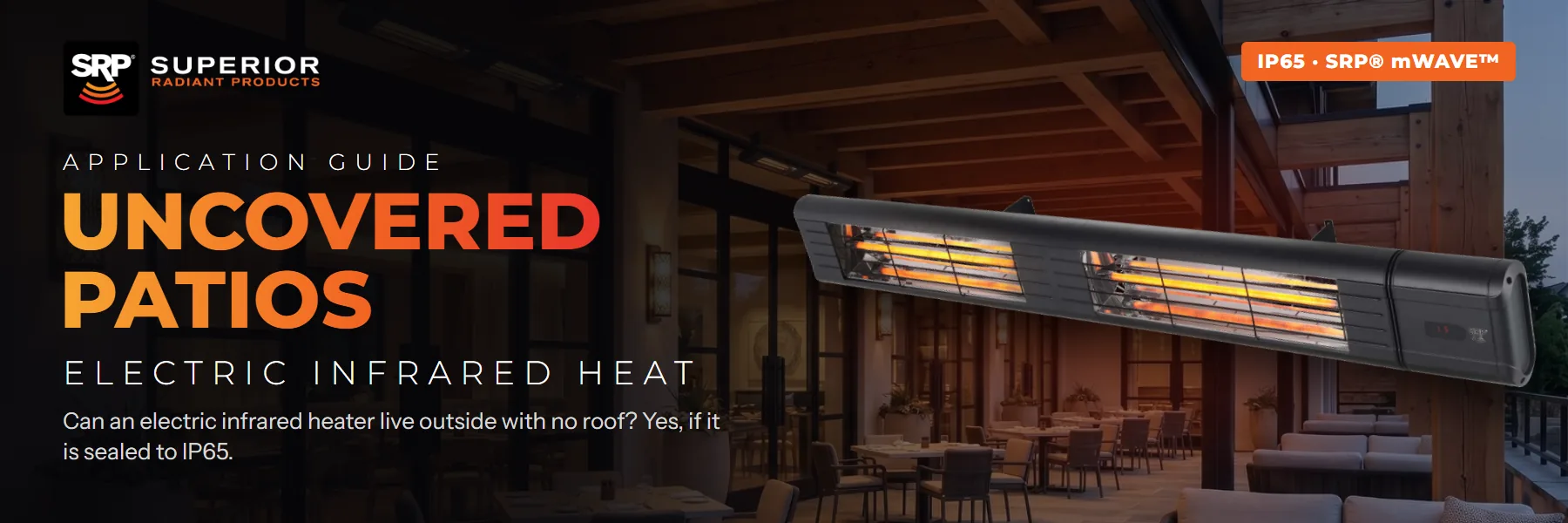
Can an electric infrared patio heater be installed on a patio with no roof?
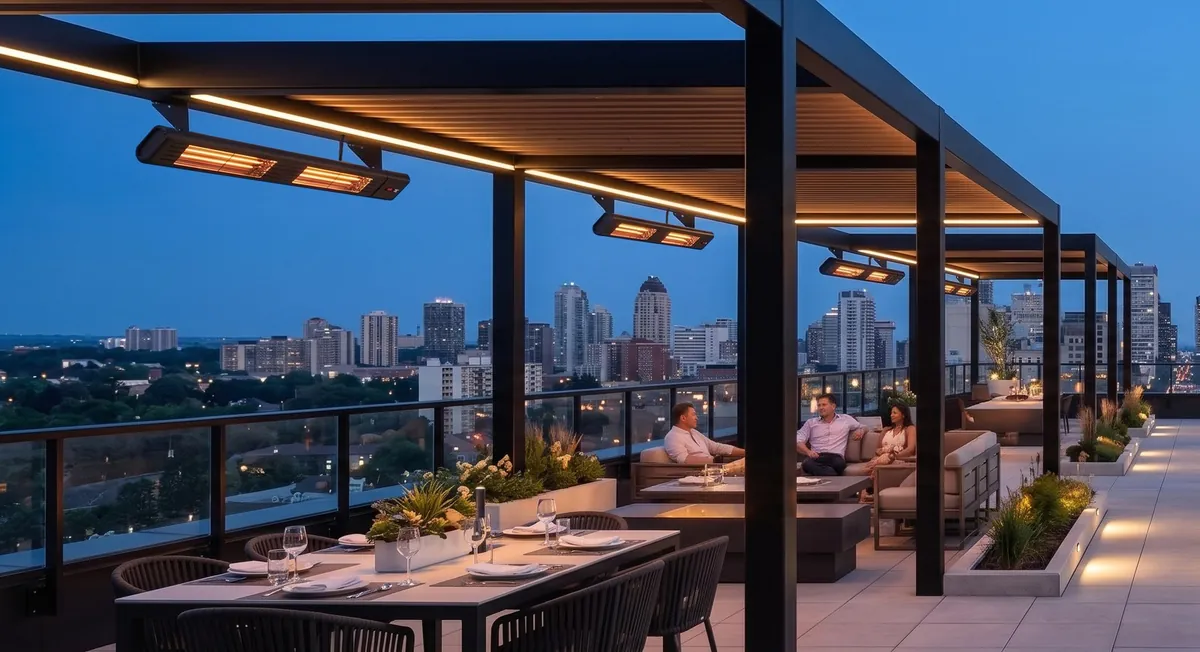
Yes, provided the heater is sealed to IP65 or better. The SRP® mWAVE™ electric infrared heater carries a fully sealed IP65 housing approved for completely unsheltered outdoor use, so it runs in rain, dust and coastal humidity with no cover or shield. It delivers 1,500 to 5,000 W of low-glare medium-wave heat and is built in North America.
Most electric patio heaters are approved for covered or partially covered spaces only, which is why open decks, rooftops and walkways so often go unheated. The one-minute video below shows the mWAVE in a restaurant patio setting; the sections that follow explain what to check before you specify one.
What IP rating does a patio heater need for rain?
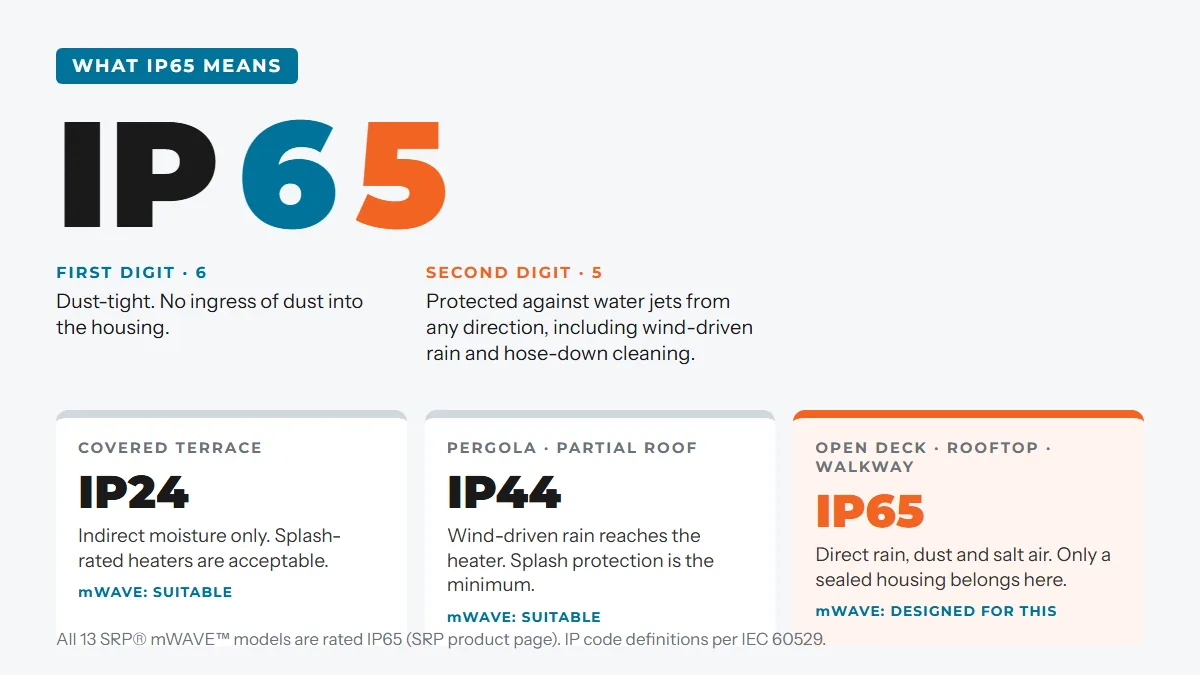
For an unsheltered patio, specify IP65. The first digit, 6, means the housing is dust-tight. The second digit, 5, means it withstands water jets from any direction, which covers wind-driven rain and hose-down cleaning. The SRP mWAVE is rated IP65 across all 13 models, per the SRP product page, so the same unit can be used covered or uncovered.
Lower ratings are common on electric patio heaters and they limit where the heater can go. An IP24 or IP44 unit tolerates splashing water, which suits a pergola or a covered terrace but not an open deck. Mounting a splash-rated heater in an exposed location shortens its life and may void its approval.
| Patio type | Weather exposure | Minimum IP rating to specify | mWAVE suitable? |
| Fully covered terrace or indoor-outdoor room | Indirect moisture only | IP24 | Yes |
| Pergola, awning or partial roof | Wind-driven rain reaches the heater | IP44 | Yes |
| Open deck, rooftop, walkway, casino patio | Direct rain, dust, salt air | IP65 | Yes, this is what it is designed for |
SRP states the mWAVE was engineered and tested for North American climates, from humid coastal regions to freezing winters, which is the range a Canadian or northern US patio actually sees between October and April.
The installation manual states the mWAVE is designed and manufactured for indoor and outdoor use to UL 2021, the standard for fixed and location-dedicated electric room heaters, and CSA C22.2 No. 46, and it carries a 12-month warranty from the date of installation (SRP mWAVE manual LT537, August 2026).
Why do some electric patio heaters glow bright orange and others do not?
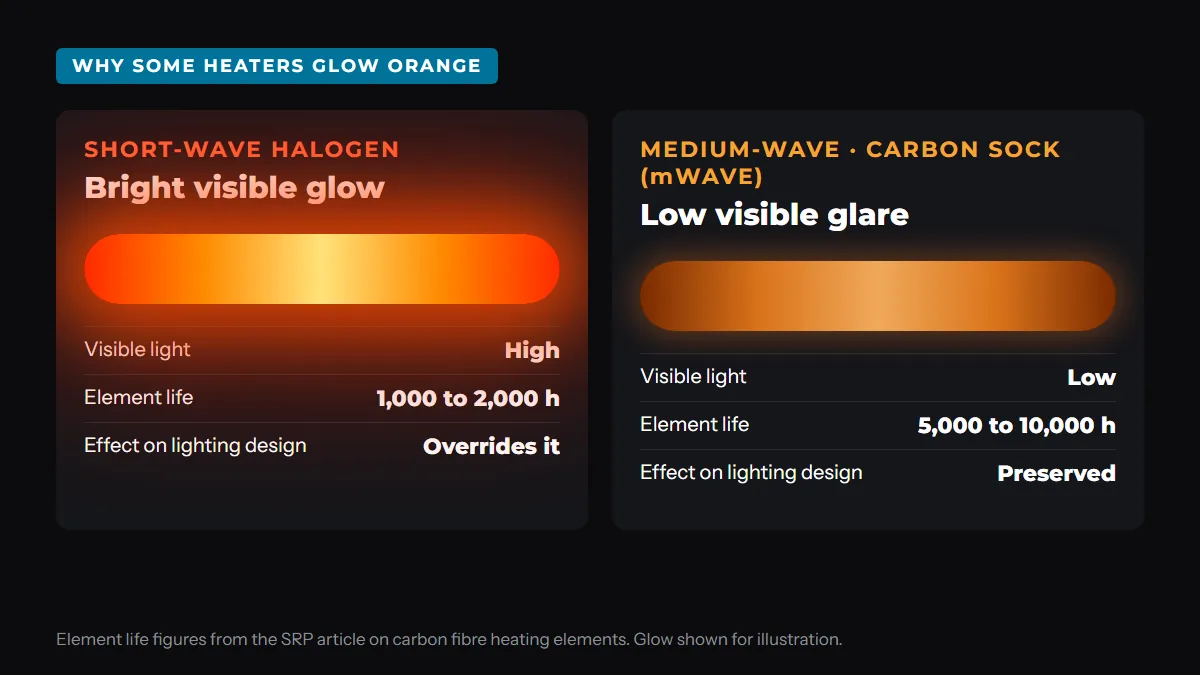
The colour of the glow comes from the emitter wavelength. Short-wave halogen elements run hottest and put a large share of their output into visible red light. Medium-wave elements run cooler and shift more of their output into the infrared band, so they warm people and surfaces with far less visible light. The SRP mWAVE uses medium-wave quartz elements with a carbon sock emitter, which SRP describes as running cooler and with less glare than a coiled-wire element.
For a restaurant or hotel the practical difference is that a low-glare heater does not override the lighting design after dark. SRP’s own article on carbon fibre emitters also puts the service life of carbon fibre elements at 5,000 to 10,000 hours, against 1,000 to 2,000 hours for halogen, so the quieter glow comes with fewer element changes.
The reflector matters as much as the element. The mWAVE uses a patented reflector with a curved geometry that, according to the SRP product page, produces a more focused radiant pattern and more even floor heat than a standard polished aluminum reflector. More of the energy you pay for lands on the guests and less leaves upward.
Should I choose 208 V or 240 V for a commercial patio heater?
Match the heater to the supply voltage that is actually at the panel, because an electric resistance heater’s output falls with the square of the voltage drop. SRP’s carbon fibre article gives the figure: a 240 V heater connected to a 208 V supply loses about 25 percent of its rated output. The mWAVE is offered in dedicated 208 V and 240 V versions of every two-lamp model so that loss is avoided.
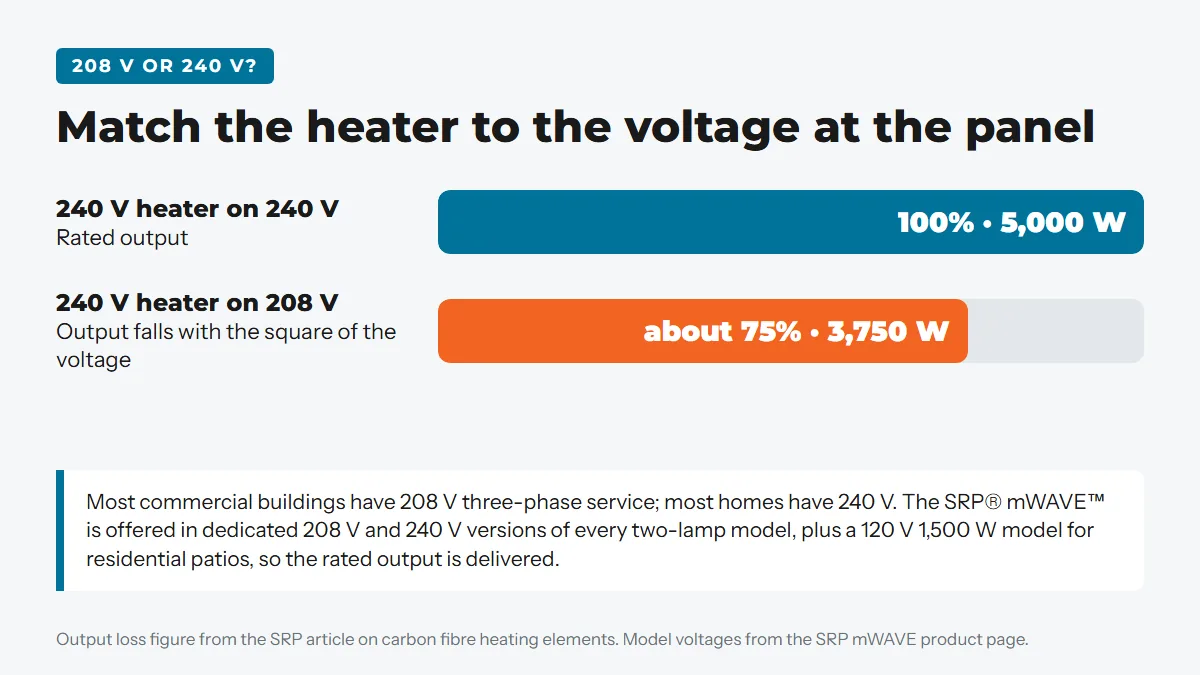
Most commercial buildings in North America have 208 V three-phase service, while residential and some light commercial sites have 240 V. The 1,500 W single-lamp model is the only 120 V unit in the range, intended for residential patios where a dedicated 120 V circuit is simpler to run.
| Output | Voltage options | Lamps | Current draw | Typical use |
| 1,500 W | 120 V | 1 | 12.5 A | Residential patio, single table zone |
| 2,500 W | 208 V or 240 V | 1 | 12.0 A or 10.4 A | Small café patio, covered walkway |
| 3,600 W | 208 V or 240 V | 2 | 17.3 A or 15.0 A | Restaurant patio rows, hotel terrace |
| 5,000 W | 208 V or 240 V | 2 | 24.0 A or 20.8 A | Open decks, casino patios, high mounting heights |
Source: SRP mWAVE product page specifications. Every unit is 8.15 in wide and 3.8 in tall; one-lamp units are 33.7 in or 37.8 in long and two-lamp units are 62.2 in or 66.5 in long depending on control version. The full 13-model table is in the mWAVE launch article.
SMART or PRO: which control version suits your patio?
Choose SMART when the operator will adjust heat from a phone or remote, and PRO when the heaters will be wired into switches, timers, occupancy sensors or a building automation system. SMART models carry a V suffix and include Wi-Fi on the Tuya ecosystem with five heat levels, 1 to 9 hour timers, zone grouping and Alexa or Google Home voice control. PRO models are direct-wired.
| Question to ask | Answer points to |
| Will staff change heat levels through the evening? | SMART, app or handheld remote |
| Is this new construction with a BAS or lighting control system? | PRO, hard-wired integration |
| Do you want heaters off automatically when the patio is empty? | PRO with an occupancy sensor, or SMART with timers |
| Residential patio, homeowner control? | SMART, with Alexa or Google Home |
| Multiple zones that should run together? | SMART zone grouping, or PRO on a shared BAS schedule |
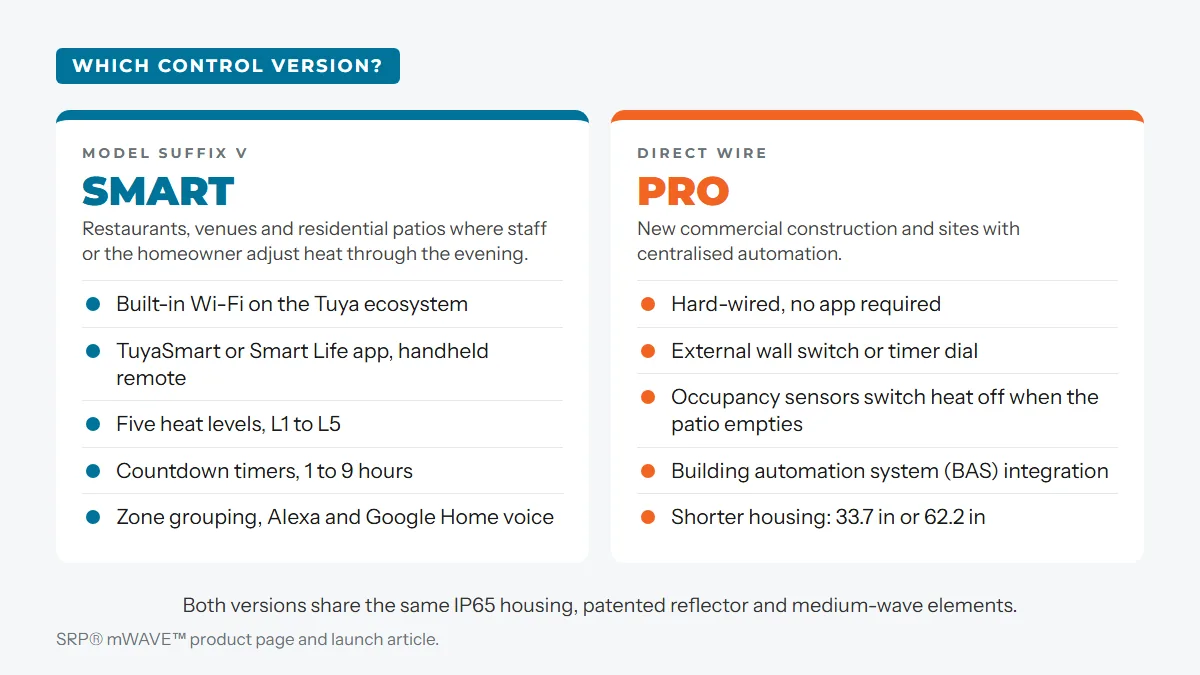
Both versions share the same IP65 housing, reflector and elements. The choice changes only the control wiring and the model length.
Which mWAVE model do I need for a restaurant patio?
Start from the installation height, then pick the wattage. SRP’s design guide recommends 8 ft for the 1.5 kW model, 8 to 10 ft for 2.5 kW, 9 to 13 ft for 3.6 kW and 10 to 14 ft for 5.0 kW. For restaurant patios and hospitality spaces at 8 to 10 ft it points to the 2.5 kW and 3.6 kW models.
| Model | Recommended installation height | Coverage at the lowest height | Coverage at the highest height |
| 1.5 kW | 8 ft (2.4 m) | 15 × 13 ft (4.5 × 4 m) | Same |
| 2.5 kW | 8 to 10 ft (2.4 to 3.0 m) | 17 × 16 ft at 8 ft | 18 × 17 ft at 10 ft |
| 3.6 kW | 9 to 13 ft (2.7 to 4.0 m) | 19 × 18 ft at 9 ft | 22 × 22 ft at 13 ft |
| 5.0 kW | 10 to 14 ft (3.0 to 4.3 m) | 24 × 22 ft at 10 ft | 27 × 26 ft at 14 ft |
Source: SRP mWAVE Design Guide LT556, August 2026. Coverage is the floor area where radiant intensity is at least 10 Btu/h per sq ft (30 W/m²). Heaters may be mounted higher than the recommended range if the layout keeps the heat inside the intended zone.
To size a patio, divide the target zone area by the single-heater coverage area at your height and round up. The design guide’s own example is a 10 × 12 ft covered patio dining area with a 9 ft ceiling: one 2.5 kW heater covers the 120 sq ft zone, mounted at a tilt toward the open edge to concentrate heat where the wind takes it.
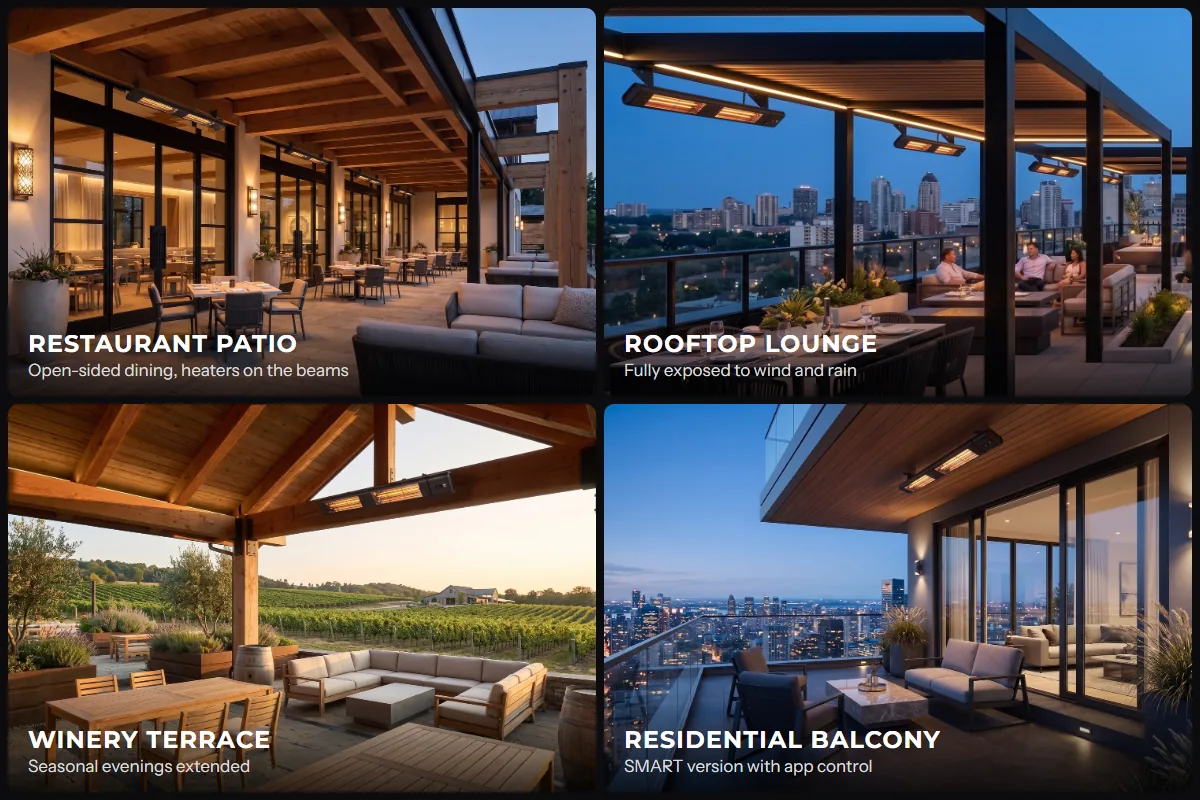
SRP lists restaurant patios and cafés, hotel rooftops and lounge bars, casino patios and resort walkways, and residential patios as the primary applications. For a layout drawing, SRP’s application support team sizes patios from a site plan at no charge.
How to specify the mWAVE
Download the submittal, design guide, installation manual and short and long specifications from the SRP mWAVE product page, then request a quote through the contact page or call 1 800 527-HEAT (4328). Superior Radiant Products designs and manufactures the mWAVE in North America and distributes through manufacturers’ representatives across the United States and Canada.
Page reviewed 30 October 2026.
FAQ Block
Does an IP65 patio heater still need a cover in winter?
No. IP65 means the housing is dust-tight and sealed against water jets from any direction, so the SRP mWAVE can stay mounted and exposed through rain and snow without a cover or shield. SRP states it was tested for North American climates from humid coastal regions to freezing winters.
Can I mount the mWAVE on a wall or only on a ceiling?
Both. The mWAVE ships with adjustable stainless-steel brackets for wall, ceiling or chain mounting, always horizontal and at least 8 ft (2.4 m) above the floor. Keep 18 in (457 mm) from walls at the heater ends, 3.3 ft (1 m) from other objects and between heaters end to end, and follow the manual’s angle-specific ceiling clearances.
Is medium-wave infrared safe to sit under?
Yes. Medium-wave infrared warms people and surfaces directly rather than heating the air, with a gentler profile than short-wave heaters that produce a bright red light. SRP describes the mWAVE’s carbon sock emitter as running cooler than a coiled-wire element, which is what reduces both the visible glare and the surface temperature of the unit.
How long do the mWAVE elements last?
SRP’s article on carbon fibre emitters puts the service life of carbon fibre elements at 5,000 to 10,000 hours, compared with 1,000 to 2,000 hours for halogen. The mWAVE launch article adds that the unit has no moving parts and rarely needs element changes under regular use.
Can the mWAVE connect to my building automation system?
Yes, with the PRO version. PRO models are direct-wired and integrate with external wall switches, timer dials, occupancy sensors or a building automation system, which suits new commercial construction with centralised controls. SMART models instead use built-in Wi-Fi and the TuyaSmart or Smart Life app.
Where can I buy the SRP mWAVE?
Superior Radiant Products sells the mWAVE through manufacturers’ representatives and distributors across the United States and Canada. Request a quote through the contact form at superiorradiant.com or call 1 800 527-HEAT (4328), and the SRP team will connect you with the representative for your region and size the patio from your site plan.

