The Physics of Infrared Reflector Efficiency: Debunking Optical Myths, Insulated Reflectors, and AHRI 1330 Performance
An infrared heater reflector is considered 100% geometrically efficient when its optical profile redirects all upward and lateral circumferential radiant rays into the occupied floor plane without trapping heat against the emitter tube or losing energy to ceiling plenum convection. While no physical material possesses zero thermal absorption, engineered 10-faceted parabolic reflectors maximize radiant output by preventing parasitic tube restrike, outperforming expensive insulated reflector configurations.
In commercial and industrial heating specifications, debates often arise regarding what “100% reflector efficiency” means and whether adding fiberglass or ceramic insulation to a shallow reflector makes it superior. Some manufacturers argue that because raw materials absorb minute fractions of heat, or because standards like AHRI 1330 evaluate the entire appliance, optical geometry is secondary.
The laws of thermal radiation and optics prove otherwise: Infrared radiation is governed by electromagnetic optical principles, not conductive insulation. Reflector geometry is the primary physical variable dictating whether radiant energy reaches the floor or dissipates uselessly into the ceiling structure.
Reflector Geometry & Technology Comparison Matrix
| Reflector Characteristic | Conventional Shallow Reflector | Competitor Insulated Reflector | SRP® 10-Faceted Deep-Dish Reflector |
|---|---|---|---|
| Optical Geometry | 3 to 4 wide-angle bends | 3 to 4 wide-angle bends | 10 critically angled specular facets |
| Emitter Tube Coverage | Ends above tube centerline | Ends above tube centerline | Extends completely below tube bottom |
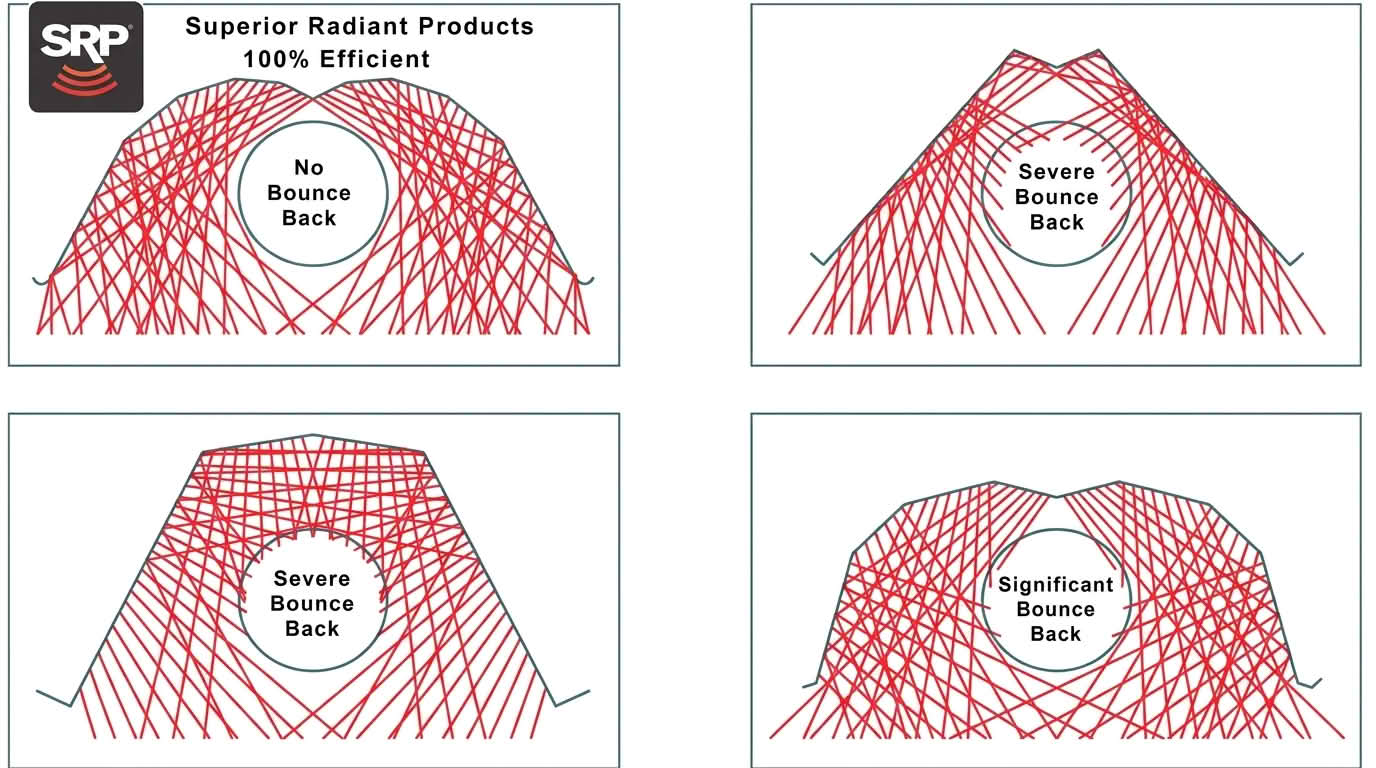
| Circumferential Ray Intercept | Up to 35% escape upward | Up to 35% escape upward | 100% of upward/lateral rays redirected down |
| Tube Restrike Rate | High (heats emitter tube) | High (heats emitter tube) | Zero (deflected cleanly past tube circumference) |
| Convective “Dead Air” Trap | Open profile; high draft loss | Open profile; relies on insulation | Deep pocket + full end caps create dead-air seal |
| Convective Shell Losses | Moderate-High | Marginal reduction | Negligible (1–3% of total appliance input) |
| Radiant Factor (EN-419-2) | Baseline | Modest improvement | >5% higher than competitor insulated; >44% higher than uninsulated |
1. What About Insulated Reflectors? The Optical Reality
In recent years, some manufacturers have added external insulation layers to their reflectors, marketing them as high-efficiency upgrades at a premium price.
While insulation can reduce the external surface temperature of the reflector sheet, insulation does absolutely nothing to fix poor optical geometry or eliminate “bounce-back” (tube restrike) deficiencies.
Why Insulation Cannot Overcome Optical Deficiencies:
- Infrared Energy Follows Optical Laws: Infrared is electromagnetic radiation. It behaves according to optical mechanisms (angle of incidence equals angle of reflection). Adding insulation to the back of an aluminum sheet cannot redirect rays that are misaligned by a shallow 3-bend profile.
- Insulation Does Not Create “Dead Air” Pockets: Insulating the metal backplate does nothing to shield the emitter tube from ambient drafts. The protective “dead air” cushion surrounding the tube is strictly a function of the deep-dish profile and precision end caps, which physically prevent warm air from spilling into the upper building envelope.
- The Law of Diminishing Returns: On an optically optimized deep-dish reflector, total convective loss from the reflector body represents only 1% to 3% of the total appliance input. Reducing that fraction by 20–25% via expensive insulation yields an insignificant net gain, all while leaving tube restrike unaddressed.
- Fixture Efficiency Governs Radiant Output: Appliance standards restrict maximum allowable tube operating temperatures. Tube temperature cannot be arbitrarily increased by insulation. The true driver of efficiency is fixture efficiency, the synergy between the burner, emitter tube, and multi-faceted optical reflector.
The Proof in Testing (EN-419-2):
Independent European radiant factor testing under standard EN-419-2 demonstrated that SRP’s standard, uninsulated 10-faceted deep-dish reflector system is >5% more effective at delivering radiant floor heat than competitive insulated reflectors, and >44% more effective than the same competitor’s uninsulated reflector.
2. AHRI Standard 1330: Why Complete Heater Ratings Rely on Optics
Critics of high-efficiency reflector metrics often state that AHRI Standard 1330 (Performance Rating of Radiant Output of Gas Fired Infrared Heaters) rates the entire heating appliance, rather than certifying aluminum sheets in isolation.
While AHRI evaluates the overall fixture, optical physics dictate the final score:
- The Tube Emits 360° Omnidirectionally: An emitter tube radiates heat evenly around its entire circumference.
- Over 50% Starts Upward: Without an optical reflector, more than half of the initial energy travels toward the roof deck.
- The Reflector Determines the Radiant Coefficient: The burner produces raw thermal BTUs, but the reflector geometry dictates what percentage of those BTUs reach the AHRI flux sensor grid on the floor versus dissipating into the ceiling plenum.
3. Eliminating “Tube Restrike” and Radiant Self-Absorption
When standard or shallow reflectors feature wide, uncalculated bends, reflected infrared rays strike back against the emitter tube:
- The Restrike Penalty: When an infrared ray bounces back into the hot tube, it is re-absorbed. This radiant energy degrades into stagnant surface heat, accelerating upward convective currents that pull heat into the rafters.
- The 10-Faceted Solution: SRP’s reflector profile utilizes 10 critically indexed reflective facets. Each angle is mathematically mapped so that rays originating from any point on the tube’s 360° circumference clear the tube profile cleanly, driving nearly 100% of the reflected energy into the occupant zone.
4. Deep-Dish Convective Barrier vs. Open Profiles
Reflectors govern both radiant optical paths and fluid dynamics:
- Shallow reflectors (even when insulated) leave the emitter tube exposed to cross-drafts, allowing forced convection to pull heat upward.
- SRP’s deep-dish profile extends completely below the bottom centerline of the tube. Combined with precision full-profile end caps, it traps a permanent envelope of warm, stagnant air around the tube, turning convective boundary layers into an insulating barrier that boosts radiant delivery.
Frequently Asked Questions: Infrared Reflector Efficiency
Does adding insulation to an infrared heater reflector make it more efficient?
No. Infrared radiation is electromagnetic energy governed by optical geometry, not conduction. Adding insulation to a shallow reflector does not eliminate parasitic “tube restrike” or redirect misaligned rays. Standard 10-faceted uninsulated deep-dish reflectors outperform competitive insulated reflectors by over 5% in EN-419-2 radiant factor testing.
What is “tube restrike” in infrared heating?
Tube restrike occurs when reflected infrared rays bounce back into the emitter tube instead of reaching the floor. This causes the tube to re-absorb radiant energy and convert it into wasted convective ceiling heat. A 10-faceted reflector eliminates restrike by angling rays cleanly past the tube’s circumference.
What does “100% efficient infrared reflector” mean in engineering specifications?
In engineering terms, 100% reflector efficiency refers to optical geometric efficiency. It indicates that 100% of the upward and lateral infrared rays emitted around the tube’s 360° circumference are captured and redirected into the lower occupied space without escaping to the ceiling or hitting the emitter tube.
How does AHRI Standard 1330 rate infrared heaters?
AHRI Standard 1330 measures the total radiant factor of a complete gas-fired infrared heater using a floor-level radiometer sensor grid. While it rates the entire appliance, the reflector’s optical profile is the single component that determines how much radiant energy successfully strikes the floor sensors.
Optimize Your Building’s Radiant Heating Design
Maximize your heating efficiency by delivering every BTU directly to the floor with precision optical geometry. Calculate your exact floor radiant coverage, compare fixture efficiencies, and design custom layouts with SRP’s engineering tools.